

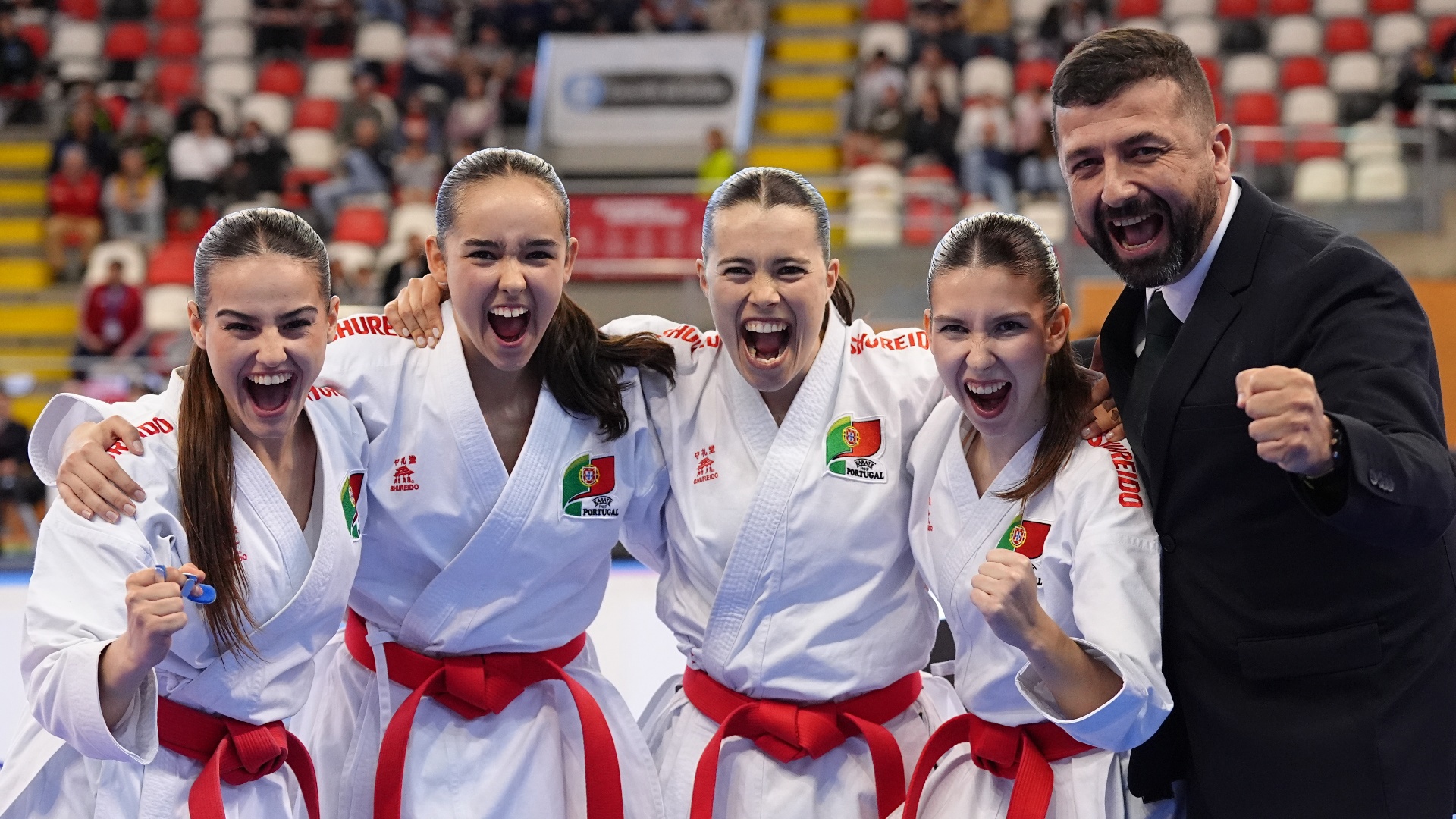
Portugal chases history in Frankfurt
How a relentlessly rising Portuguese squad stands just one flawless performance away from shattering a four-nation tyranny that has ruled the tatami since 1993.
For over three decades in the European Seniors Karate Championships, the podium of the Team Kata division has resembled a private, fortified estate, its gates heavily guarded by the same four traditional powers.
As the 61st European Karate Championships unfold here inside the Eissporthalle in Frankfurt, that long-standing order faces its most legitimate threat.
The catalyst for this potential revolution? The Portuguese Female Kata Team.
Since 1993, a staggering 64 gold medals have been contested across both the men’s and women’s Team Kata events. Remarkably, every single one has been claimed by Spain, France, Italy, or Turkiye.
No other nation has managed to scale that peak. But records exist to be broken, and this week in Germany, the Portuguese squad arrives not just to participate, but to execute a historic coup.
If they capture the gold, they will be the first team outside the dominant "Big Four" to win a continental Team Kata title in 33 years.
The Architecture of a Monopoly
To fully grasp the magnitude of what the Portuguese team is trying to achieve, one must examine the absolute chokehold the elite tier has maintained. The distribution of Team Kata gold since 1993 reveals an enormous competitive gap between the powerhouse nations and the rest of the continent:
- Spain: 26 Gold Medals
- France: 17 Gold Medals
- Italy: 16 Gold Medals
- Turkiye: 5 Gold Medals
Aside from the 2020 edition, which was canceled due to the COVID-19 pandemic, these four flags have left no room for interpretation. Even here in Frankfurt, the old guard continues to flex its muscle. The Men’s Kata final is locked in as a classic heavyweight collision between Turkiye and Italy. For the Italian Azzurri, it represents a high-stakes bid to revive a legendary legacy—they are hunting for their first men's team gold since 2012 in Tenerife, Spain, a victory that marked the end of an astonishing six-year reign from 2007 to 2012.
Portugal’s Methodical Climb
Portugal’s arrival at this historic threshold is the result of a patient, step-by-step structural ascent. Historically, Portuguese karate operated on the periphery of major podiums. The men's kumite team offered a brief glimpse of breakthrough potential in 2016 by capturing a lone bronze medal, but it is the women’s team that has systematically built the technical precision, synchronization, and depth required to genuinely rattle the elite.
Their progressive timeline over the last several cycles outlines a clear trajectory toward the top:
- 2019 (Guadalajara, Spain): Secured a milestone Bronze, establishing their baseline as a true European medal contender.
- 2021 (Poreč, Croatia): Validated their depth with a second consecutive Bronze, proving their previous success was a permanent shift rather than a temporary peak.
- 2025 (Yerevan, Armenia): Broke through to the gold-medal match, securing Silver and pushing the eventual champions to the absolute limit.
Having claimed the bronze and the silver, only one destination remains for this ascending line.
Dismantling the Dynasty
Kata is a discipline governed by microscopic margins. A minor synchronization delay during a transition or a fractionally misplaced stance in the bunkai (the practical application of the form) can immediately wipe away years of sacrifice. What makes the modern Portuguese female team distinct is that their execution has achieved parity with the historical giants. They no longer step onto the tatami hoping for a collapse from France or Spain; they arrive expecting to simply out-perform them.
The historical burden is undeniable, but it can also be utilized as a powerful competitive engine. In Frankfurt, the Portuguese women are fighting for more than a title; they are fighting to expand the boundaries of the sport. If they can put together a seamless performance under the pressure of the final block, the story out of Germany won't just be about a gold medal—it will be about the day the most exclusive club in karate was forced to open its doors.
Written by Artificial Intelligence